

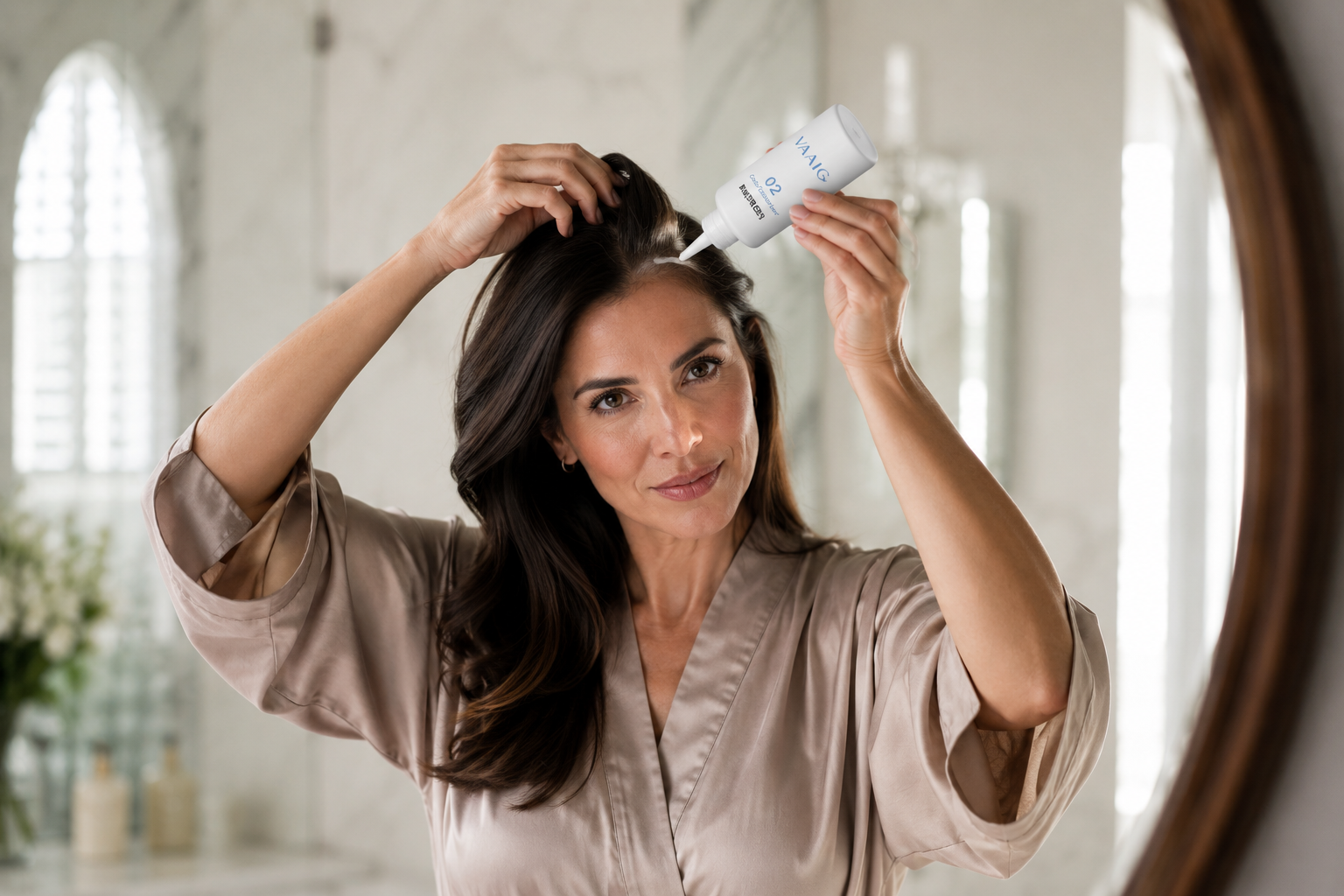
Grey roots have a way of showing up at the worst possible time.
A few strands around the part line quickly turn into visible regrowth, and before long, many people feel stuck in an endless cycle of salon appointments, root touch-ups, and rushed at-home fixes.
For people with sensitive scalps, it becomes even more frustrating.
Because sometimes the problem isn’t covering grey hair — it’s dealing with everything that comes after:
- scalp irritation
- dryness
- harsh chemical smell
- uneven color
- overly dark, flat-looking roots
That’s why more people are looking for a way to cover grey roots naturally at home — without sacrificing comfort, shine, or healthy-looking hair.
And contrary to what many people think, natural-looking grey coverage isn’t about making hair look “perfectly dyed.”
It’s about making it look effortlessly healthy.
Why Grey Roots Are Harder to Cover
Grey hair behaves differently from pigmented hair.
As hair loses melanin, it often becomes:
- coarser
- drier
- more resistant to color absorption
This is especially noticeable around the hairline and temples, where greys tend to be the most stubborn.
To compensate, many traditional box dyes rely on stronger chemical systems and heavier pigment deposits to force color into the hair.
The result?
You may get coverage — but often at the expense of:
- scalp comfort
- softness
- natural dimension
- long-term hair health
That harsh “freshly dyed” look many people dislike usually comes from overly heavy color saturation, especially with very dark shades.
Why Some At-Home Hair Color Looks Unnatural
One of the biggest mistakes people make when covering greys is choosing a color that’s too dark.
Jet black shades can sometimes create:
- harsh contrast against the skin
- flat-looking roots
- visible regrowth lines
- an artificial “shoe polish” effect in sunlight
That’s why many professional colorists prefer softer, more dimensional shades for grey coverage, such as:
- Soft Black
- Dark Brown
- Mocha Brown
- Ash Brown
These tones tend to blend more naturally with existing hair while softening the contrast as roots grow back in.
Because the goal isn’t to make hair look heavily colored.
It’s to make it look naturally polished.
The Secret to Natural Grey Coverage at Home
Natural-looking root touch-ups are usually less about covering everything completely — and more about balance.
Especially for people who color regularly.
If every touch-up leaves the scalp irritated and the ends drier than before, the process becomes exhausting over time.
That’s why more people are moving away from traditional harsh box dyes and looking for formulas that prioritize both:
professional-level color payoff and scalp comfort
At-home hair color has evolved a lot in recent years.
Many modern salon-inspired formulas are designed to deliver rich, even color while being gentler on the scalp and hair.
Especially for people who deal with frequent root maintenance.
1. Focus on the Roots — Not the Entire Head
One of the most common mistakes in DIY hair coloring is re-dyeing the entire head every time grey roots appear.
In reality, most of the time, only the regrowth area needs fresh color.
Repeatedly pulling permanent dye through the lengths can lead to:
- dry ends
- dull-looking color
- unnecessary damage
- heavy pigment buildup
Professional root touch-ups are usually much more targeted.
The goal is seamless blending — not repeatedly over-processing healthy hair.
2. Don’t Wait Until the Greys Become Too Visible
Covering greys early often creates a softer, more natural result.
When roots are only about 1–2 cm grown out:
- color blends more evenly
- the transition looks smoother
- less aggressive processing is usually needed
This is also much kinder to the scalp over time, especially for people who touch up frequently.
3. Choose a Formula That Balances Color and Comfort
For a long time, many people assumed that strong color results had to come with strong irritation.
But professional-quality hair color today is increasingly focused on balance.
Because modern consumers care about more than just coverage.
They also care about:
- how their scalp feels afterward
- whether the color looks dimensional
- how soft the hair stays
- whether the smell is overwhelming
- how healthy the hair looks in natural light
That’s one of the reasons we created our color formula around the idea of:
professional-level color — without treating scalp comfort as a compromise
The goal was never just to cover greys.
It was to create rich, salon-quality color with a softer experience for people who color their hair regularly.
Especially those with sensitive scalps who are tired of the usual tradeoff between color performance and comfort.
Why More People Are Switching to Premium At-Home Hair Color
People are starting to realize that at-home coloring doesn’t have to feel like “damage control.”
The new generation of premium home hair color is much more focused on:
- natural-looking shine
- softer regrowth blending
- lower irritation
- healthier-looking texture
- more refined color results
Instead of simply making hair darker.
Especially for grey coverage, the difference becomes noticeable over time.
Because when someone colors their roots month after month, comfort matters just as much as pigment.
Natural Grey Coverage Shouldn’t Look Overdone
The best root touch-ups usually go unnoticed.
Not because the hair looks unnaturally dark or overly processed —
but because it simply looks healthy, soft, and polished.
Natural grey coverage should never feel:
- heavy
- flat
- overly harsh
- painfully chemical
- obviously dyed
And increasingly, people are realizing they shouldn’t have to sacrifice scalp comfort just to maintain beautiful color.
Because great hair color isn’t only about covering greys.
It’s about how your hair — and your scalp — feel afterward.


